



Every day, thousands of people walk into primary healthcare centers across Africa with one expectation: to receive safe, quality healthcare.
A mother arrives with her child, hoping for answers to a persistent fever. A healthcare worker begins another shift, determined to provide the best possible care with the resources available. Neither may be thinking about health system resilience, outbreak preparedness, or health financing.
These became the focus at the 2nd Africa Primary Health Care Forum (APHCF) 2026 in Abuja, Nigeria, where policymakers, healthcare professionals, researchers, development partners, and innovators explored how stronger primary healthcare institutions can improve health outcomes across the continent. The Dr. Ameyo Stella Adadevoh (DRASA) Health Trust was represented by members of its team who participated in the conversation and presented learning from their work. ,
Chidinma Ibe, Infection Prevention and Control (IPC) Program Manager, participated in the conversations around practical strategies for strengthening health institutions through prevention.

As discussions unfolded, one message emerged repeatedly: the most resilient health institutions are not defined by how effectively they respond to disease, but by how successfully they prevent it. Detecting health threats early, preventing infections, and protecting communities before outbreaks occur are among the strongest indicators of a resilient health system. Prevention is not simply a public health strategy. It is the foundation upon which safer healthcare and healthier communities are built.
This perspective reflects the work we do at DRASA. We believe that infection prevention and control does not begin during an outbreak. It should be integrated into everyday healthcare to protect patients, safeguard healthcare workers, strengthen outbreak preparedness, and build trust in the health system long before an emergency occurs.
Another recurring theme at the forum was the importance of collective action. Stronger health institutions cannot be built in isolation. Governments, healthcare workers, researchers, development partners, and communities each contribute to creating accountable, resilient health institutions prepared for future health threats. When infection prevention becomes part of routine healthcare rather than a stand-alone activity, health institutions are better equipped to protect lives every day, not only during public health emergencies.
Innovation also featured prominently in the discussions. From digital health solutions and artificial intelligence to better use of data, technology is creating new opportunities to improve primary healthcare, and should strengthen people, not replace them. Digital tools are most effective when they support healthcare workers, improve decision-making, strengthen disease surveillance, and ultimately make healthcare safer for everyone.
DRASA also brought its own work in digital health and community-based surveillance into this conversation. During the scientific poster session, Ayobami Akiode, representing DRASA, presented a poster titled “Explainable Machine Learning for Predicting Community Outbreak Reporting Readiness.” The research explored how implementation research and artificial intelligence can be applied to strengthen community-based surveillance, using baseline data from the SCOPED survey conducted in the Federal Capital Territory, Enugu, and Oyo States.
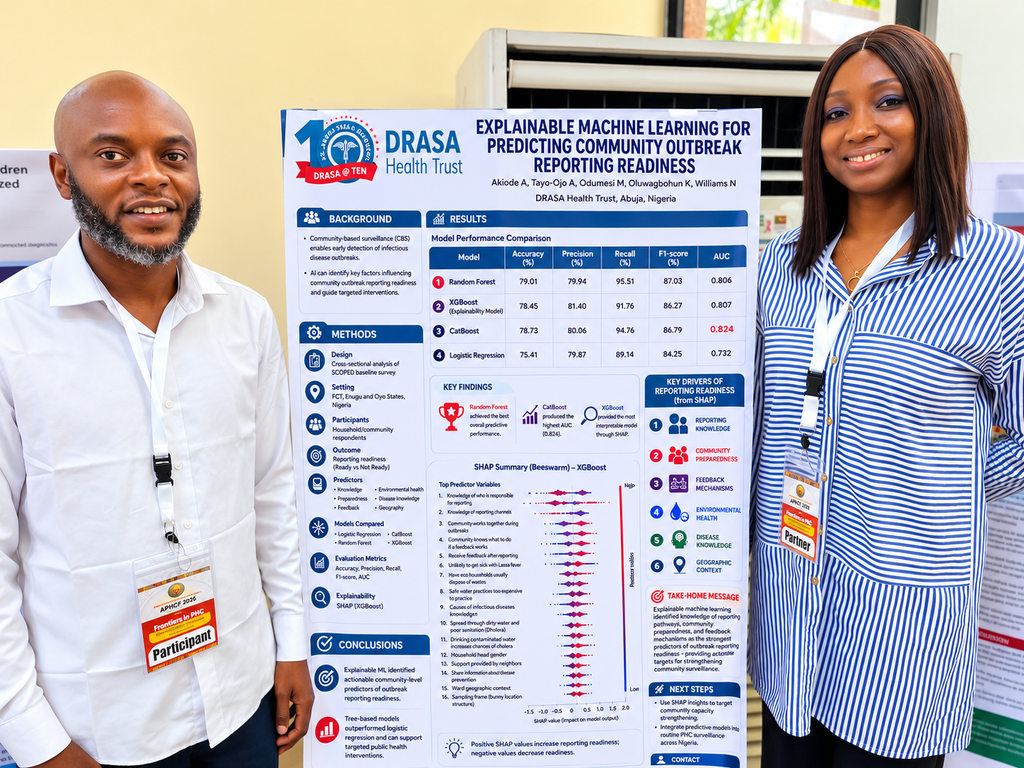
The machine learning model identified and indicated factors that predict an individual’s readiness or unreadiness to report a potential disease outbreak to the appropriate individuals/community informants. The model identified being knowledgeable about who to report to about a disease outbreak, being knowledgeable about the reporting channels/facilities to report disease outbreak, living in a community where they work together during outbreak, living in a community where there is high community-level knowledge about reporting, and receiving feedbacks after disease reporting as key predictors of an individual’s readiness to report a potential disease outbreak. These findings highlight and emphasize the highly significant role of communities in improving an individual's readiness to reporting potential disease outbreaks to the appropriate channel.
Presenting this work gave DRASA an opportunity to share evidence from its implementation experience with researchers, health practitioners, digital health experts, development partners, and other stakeholders from across Africa. The poster session also generated discussions around implementation approaches, monitoring systems, evidence generation, and opportunities to apply artificial intelligence and other digital tools to strengthen public health systems.
The forum also reinforced the message that communities are not passive recipients of healthcare, but essential partners in building accountable health institutions. Lasting progress depends on listening to communities, understanding the realities they face, and developing solutions alongside them. When communities are engaged, prevention becomes part of everyday life, health information is more reliable, and public health interventions become more sustainable.
Beyond the poster presentation, DRASA’s participation created opportunities to engage with organizations and experts working across digital health, health informatics, disease surveillance, and health systems strengthening. These conversations opened possibilities for future collaboration around areas such as geospatial technologies, interoperable health information systems, AI-enabled public health solutions, digital monitoring and evaluation, community-based surveillance, and implementation research.
The conversations in Abuja extended beyond policy discussions and technical presentations. They were about the mother who deserves safe care when she walks into a health facility. They were about the healthcare worker who needs the knowledge, support, and resources to provide that care safely. They were about communities that are better prepared to prevent outbreaks before they escalate and health institutions that are built to protect people at every stage of care.
For DRASA, the journey does not end when the conversations end. It continues with translating shared ideas and evidence into meaningful action by strengthening infection prevention and control, supporting responsive health approaches, advancing evidence-informed innovation, and developing Health Champions who are helping create healthier, safer communities. Because every conversation that leads to action brings us closer to a future where no one suffers from preventable infectious diseases.